
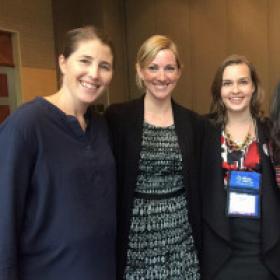
NEDA is so excited to be here in the bustling Chicago area for the 2016 NEDA Conference! This year’s Conference is themed, “The Sky’s the Limit: Advances and Insights in Eating Disorders Treatment and Prevention.”
Attendees kicked off the day with a Shire-sponsored breakfast with Monica Seles, renowned tennis player and author of Getting a Grip: On My Body, My Mind, My Self.
Sharing her experience with binge eating disorder (BED), Monica said, “...I thought it was just me, but I realized that millions are struggling and I'm not alone.” The discussion was moderated by the Multi-Service Eating Disorders Association (MEDA).
Afterwards, attendees headed over to It's Complicated: Eating Disorders in the Age of Social Media, this year’s keynote NEDA Conference session. This engaging presentation explored eating disorder communities and featured representatives from Facebook and Instagram, as well as Nancy Zucker, PhD, from Duke University.
As Dr. Zucker aptly stated, “Our lives on Facebook are curated,” and many social media users fall into the trap of judging our status and performance in relation to other people. As many others have said before, it’s comparing your everyday life to someone else’s highlight reel.
According to Dr. Zucker, many of those who struggle with eating disorders have experienced a lack of intimate attachments in their lives. While pro-eating disorders websites can appear malicious on the surface, those postings are an opportunity to deliver support and resources into the hands of those struggling the most.
Maggie Cook, Facebook’s program and partnerships manager, pointed out that social media can provide resources and strengthen connections between friends and family. Facebook’s reporting tool doesn’t aim to diagnose people, but to provide empathy and options for those who might be struggling.
Representing Instagram, Karina Newton discussed Instagram’s global reporting and reviewing system. When someone reports a post, Instagram’s global team will review that post. Users can report self-injury and other concerns anonymously. Individuals can also use filters to customize their experience. Don’t like the word “diet,” for example? You can banish the term from your comments section with Instagram’s handy filter.
By the end of the presentation, one thing was clear: social media is an immeasurably powerful tool for connection. But it’s how we use that power that counts.
This year’s engaging keynote presentation was followed by a lineup of concurrent sessions, including NEDA in a Nutshell: Programs for Activism, Advocacy and Support presented by NEDA staff members. During our NEDA in a Nutshell presentation, staff members spoke about specific ways that NEDA’s programs and services have changed lives. Those of you at home can learn more about NEDA’s many ways to get involved here.
I also had the opportunity to attend an important panel discussion titled Treating Boys with Anorexia: Clinical Issues and Supporting Family Caregivers by Jessica L. Whitney, PhD, Merle A. Keitel, PhD and Melinda Parisi, PhD. This fascinating talk touched upon the role of primary caregivers in eating disorder recovery, especially parents, who often struggle with marital strains and maladaptive coping from the experience. A son struggling with anorexia challenges gender norms, and many boys and men experience isolation in eating disorder recovery spaces, which are often women-centric.
As panel members pointed out, if a child has cancer, there is an acknowledgement of the terror faced by the parents of that child. But if a child has anorexia, parents and caregivers feel guilt and marginalization.
Attendees also experienced an educational session by S. Bryn Austin, ScD titled Accelerating Progress in Eating Disorders Prevention: A Call for Policy Translation Research and Training. Over the course of her presentation, Austin discussed interventions at both the macro and micro levels. In order to accelerate progress in eating disorder prevention, it is vital to use a macro approach instead of exclusively targeting individuals. Macro approaches could include legal options for regulating Photoshop and other forms of deceptive advertising, for example.
Other sessions of note included:
•Advances in the Treatment of Binge Eating Disorder by Ann Kearney-Cooke, PhD
•Youth Creating Change: Partnering With Teens to Stop Weight Bias in Schools by Carmen Cool, MA, LCP
•Culturally Sensitive Treatment for Eating Disorders: Considerations Across Diverse Populations by Mae Lynn Reyes-Rodriguez, PhD
For a full list of today’s informative sessions and to learn more about the 2016 NEDA Conference, visit nedaconference.org.
Stay tuned for another Conference recap tomorrow, and remember: you can always follow the action on social media by searching #NEDA2016!