

Later this month, the American Psychiatric Association will release its new edition of the Diagnostic and Statistical Manual of Mental Disorders (DSM-5). In an article on May 6, 2013, the New York Times reported that Dr. Thomas R. Insel, Director of the National Institute of Mental Health (NIMH), stated that "his goal was to reshape the direction of psychiatric research to focus on biology, genetics and neuroscience so that scientists can define disorders by their causes, rather than their symptoms."

I have not been an avid social media user, but recently, friends and acquaintances have brought to my attention that there are literally millions of sites that promote and encourage anorexia, (Pro-ana), bulimia (Pro-mia), and thinness (Thinspo & Thinspiration). They shared their concerns about these sites with me, knowing that my daughter, Shelby, had died from eating disorders.
In February, University of California - San Diego held a conference on the translation of new eating disorders research into innovative treatment approaches. One of the highlights of the conference was Dr. Walter Kaye, Director of the UCSD Eating Disorders program discussing:
“When Good Traits Go Bad: Clues to More Effective Treatments for Eating Disorders”

When First Lady Michelle Obama began the Let's Move! campaign, a lot of eating disorders activists and organizations were concerned about its focus on obesity and comments made by Mrs. Obama about putting her child on a diet. Many of you wrote to her to vocalize concerns about these messages and, lately, there appears to be a shift in messaging toward language that emphasizes overall wellness, as opposed to weight or size.

This week, CNN reported on a recent proposal that airlines charge passengers based on their body weight in order to reduce fuel cost. The proposals were conceived by economist Dr. Bharat P. Bhatta, associate professor of economics at Sogn og Fjordane University College, Norway and recently published in the Journal of Revenue and Pricing Management.
Three “pay-as-you-weigh” models being suggested are calculated on total weight, including:

If you could unlock a recovered eating disordered brain to peer inside most people would be amazed at the distinct memories of the journey. As a seasoned nurse, perhaps my memories are more technical than a non-healthcare professional, but whether you are a nurse, college student, or stay at home mom, there are healthcare providers you recall with compassion and those you remember for their unfortunate ignorance. Why do so many healthcare providers disregard the possibility of underlying eating disorder issues and simply treat presenting symptoms?

On March 25, 2013, Governor Bob McDonnell signed the bill for parental education and school screenings for eating disorders into law. This marks a landmark victory in the fight against eating disorders.

Itʼs been a year since my sister Anne succumbed to the anorexia that plagued her life, off and on for nearly 25 years. Iʼve learned a lot about her illness and why she suffered from it for so long. I share my story to reach out to others who have a loved one struggling, or may be concerned about someone in their life, to encourage them to become as educated as possible and be an advocate for awareness about the seriousness of these potentially life-threatening illnesses.

The National Eating Disorders Association (NEDA) and The Model Alliance (MA), a non-profit dedicated to improving working conditions in the American fashion industry, co-hosted the panel event, Inside The Modeling Industry: A Conversation About Health & Beauty In Fashion at Pace University for 2013 NEDAwareness Week. MA founder, Sara Ziff, moderated the panel discussion which featured models Crystal Renn, Katharine Schuette and Amy Lemons, modeling agent Chris Gay, eating disorder specialist Dr.
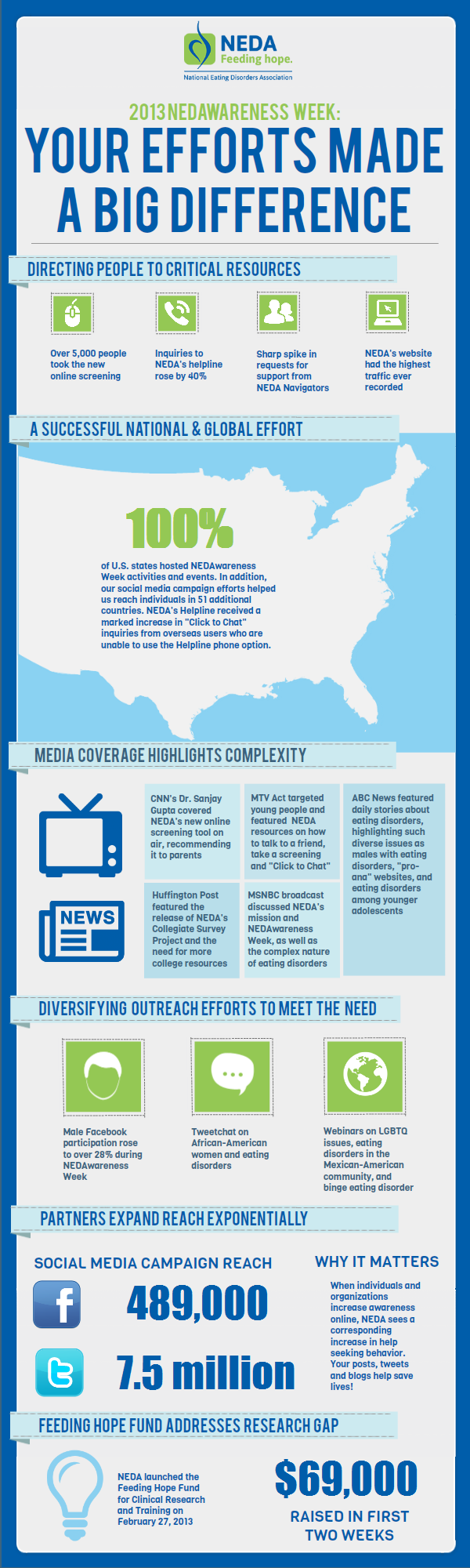
NEDAwareness Week 2013 was once again a great success in raising awareness about eating disorders and directing people to the help they need. Participation spanned the country and across the globe, reaching people with critical information and resources about these potentially life-threatening illnesses.