

When I heard that women had been turned away from the Cannes Film Festival for wearing flats, I was frustrated. Not only were they discriminated against for their apparel choices, but for making healthier, safer ones. I was also, I’m embarrassed to admit, envious of those women. It would have taken courage for me to attend an upscale event in flats. That really got me thinking.

Free yoga classes! Lower health insurance premiums! Discounts and cash! And all you have to do is participate in your workplace wellness program! Good deal, right?
In theory, it makes sense to use incentives to encourage employees to improve their health. But in practice, many of these “voluntary” programs are discriminatory and can be especially dangerous to those affected by eating disorders.
Eating Disorder Recovery and Transgender Identities
Part Two of a Three Part Series
As I mentioned in part one of this series, one of the biggest fears I had when I first realized that I was transgender was whether my feelings were real or due to my body image distortion and eating disorder.
Two questions that I immediately raised were:
Part One of a Three Part Series

The Missouri General Assembly has passed SB 145, important legislation which, if signed by Governor Nixon, will require health benefit plans to cover the diagnosis and treatment of eating disorders in the state.
Truth #1: Many people with eating disorders look healthy, yet may be extremely ill.
Truth #2: Families are not to blame, and can be the patients’ and providers’ best allies in treatment.
Truth #3: An eating disorder diagnosis is a health crisis that disrupts personal and family functioning.
Truth #4: Eating disorders are not choices, but serious biologically influenced illnesses.

UPDATE: Memorial Service Planned
Celebration of Life in Honor of Lynn Grefe
Saturday, June 6, 2015 at 10:00 AM
Church of the Good Shepherd
1576 Palisade Ave
Fort Lee, NJ 07024
Memorial Service Notice

When Dr. Theresa Larson was in the Marines, she began to suffer from an eating disorder. For fear of losing her job, she looked towards outside help that told her what she already knew; she could not open up about her disease. She continued to stay in the military, but when she realized she needed to get help, and opened up, she received backlash rather than help. Larson was questioned about her disease, and was unable to obtain help that understood her disease. She was discharged and was sent to doctors, but none of them specialized in eating disorders.
Nearly one in five women and one in 71 men report being raped at some point in their lives, according to the Center for Disease Control. Given the shame and other complexities that keep many victims from reporting the crimes, these numbers are likely lowball—and don’t include other kinds of sexual violence, such as unwanted sexual touch.
Along with other challenging and potentially debilitating effects of sexual assault comes a high risk for poor body image, disordered eating and full-fledged eating disorders.

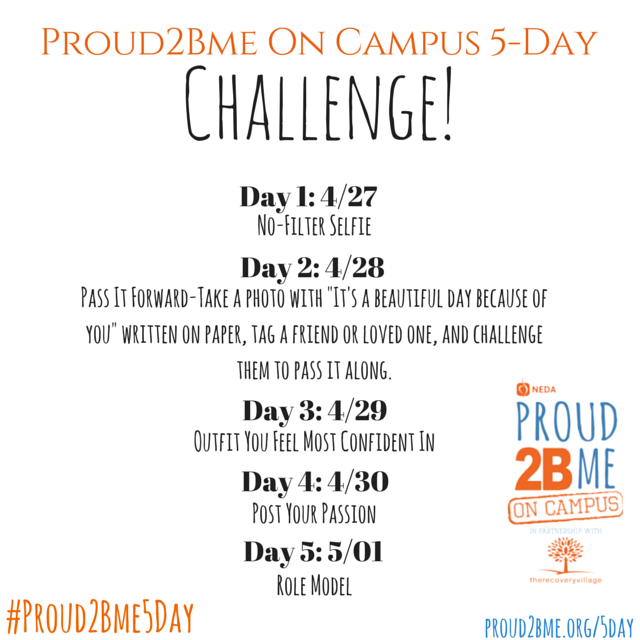
For the week of April 27th–May 1st, the CSU Northridge Proud2Bme On Campus team has created a 5 Day Photo Challenge activity on social media. The idea came about after a successful week of campus events during NEDAwareness week.