
While both anorexia nervosa and bulimia nervosa are associated with a litany of medical complications , with timely and successful treatment the vast majority of these complications do not leave permanent residual sequelae (conditions that are the result of a previous disease).

Early intervention. The phrase can sound like a negative judgment to a parent whose child has been in treatment for an eating disorder for multiple years. The mind returns to the time that the clues began appearing and wonders anxiously, “What if I had done x or y then? Would I have staved off the ED? If I had been more vigilant, more protective, stood like a demon mother with a pitchfork outside my daughter’s bedroom door, would I have prevented the eating disorder from getting in?

In November 2007, sitting alone in my cluttered, overly crowded and chaotic shared dorm room, huddled under mounds of blankets with a random episode of Buffy the Vampire Slayer playing in the background, I opened my laptop and set out on a journey to put a name to what I had been silently suffering from every day for months.

In thinking about trying to alleviate some of the tremendous suffering that comes with struggling with an eating disorder, there is nothing more urgent than earlier recognition and identification of those at risk. Early intervention is essential to a better prognosis for those affected—and nowhere is this more important than those struggling with eating disorders who are further marginalized by virtue of not “looking” like the typical someone with an eating disorder. Which brings us, obviously, to papyrus.

Treatment works best when delivered early.

Have you ever felt so full, yet you couldn’t stop eating? Do you often eat in secret because you are ashamed to eat in front of people? Do you feel unworthy or unlovable, and use food to comfort yourself in spite of your adamant commitment to weight loss?
If you or someone you know experiences this ongoing torment, you (they) may be struggling with binge eating disorder .
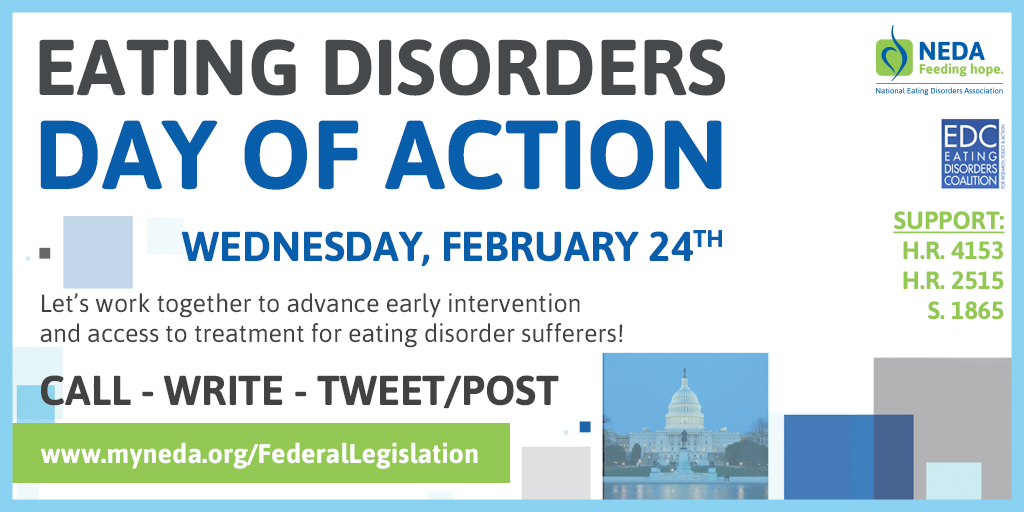
With the national spotlight on eating disorders during National Eating Disorders Awareness Week, it’s a great time to educate our elected leaders from across the country about eating disorders, and to ask for their support of important legislation that would have a positive impact on our community. That is why we are dedicating Wednesday, February 24th to a Day of Action, and we invite you to join us!

National Eating Disorders Awareness Week kicks off Sunday, February 21st and landmark buildings across the country will be lit up in blue and green to shine the spotlight on eating disorders! Listed below are the names of buildings that will be illuminating their buildings in honor of #NEDAwareness week and WE NEED YOUR HELP! If you live near one of these landmarks, please take pictures and tweet/Instagram/Facebook them with the hashtag #NEDAwareness and email them to

When I think about what it takes to recover from an eating disorder, it is really many things working together … it is not just getting treatment, being motivated, or having a good support system. Recovery is a recipe, and community support can be a big part of that recipe. Events like the Twin Cities NEDA Walk provide those in any stage of recovery (and their families and support systems) a chance to get together and cheer each other on with hope and inspiration.

While volunteering at a Los Angeles animal shelter, I met a brindle, ten-month-old pit bull named Sunny. She was very undernourished, and her tail looked like it had been chopped in half and then stomped on in three places. Yet despite her dire circumstances, a joyful energy moved through her. Every time I slipped inside her kennel, she came barreling into my arms and sprawled across my lap—her whole body wagging along with her stub tail.